 |
| Source www.nutricion-dietas.com |
perform a laborious, meticulous to the smallest detail and the result is a mystery of nature that results in a product sweet, delicious, nutritious and medicinal . The honeybees of reduced size is responsible for i ng the honey, these are part of a colony to swarm called, are a well-organized unit that follows the guidelines of a sap nature. And although they work throughout the year, Spring is a key date for the production of honey . The work of these animals will help children understand that living things are part of a food chain in which all the elements we need to survive. The taste of honey captivate the kids with a single scoop, from Educambiente we recommend that they bear to try this food if you do not know their taste, so it will be easier for them to take into account the explanations they you gave in class or at home on this subject.
As we have pointed out the organization and work of the bees is very curious There are different types of bees , community sent to the scout bees to locate flowers when they do return to the hive and warn the rest of his discovery, quality and quantity of such a buzzing from their wings or movements or smells the rest the explorer to reach the flowers.
Worker bees fly with good capacity to take care of nectar and pollen of flowers and transport it to the hive. The worker bee p one running their salivary glands and produces an enzyme, and properties transferred by nectar become honey. This type of insect cells built to store the honey from wax , a subject that generates itself. The cells are hexagons, in this way reaches its maximum storage capacity. When a cell is full of honey, bees are responsible for closing and sealing with a layer of wax called operculum, this eliminates the possibility of fermentation of the honey from absorbing water.
 |
| Source www.sencilloyfacil.com |
The rest of the worker bees is dedicated to the care internal hive Are assigned roles from the age of the bee : The youngest clean, as adults care for larvae, build honeycombs, stored pollen and honey in the cells and, later, defend the hive. The bees fans have a very important task also beat their wings at the entrance to the hive to keep the temperature at proper levels to prevent not alter the properties of honey.
collecting bees deposit the sipped nectar in their crop or 'bag of honey', when they return to the hive regurgitate it into cells or delivered to other workers for the store. proper temperature of the hive, resulting in the maturation of the honey. "
addition to nectar, bees collect pollen of flowers to the hive when they deposit it in the cells, thus facilitating optimal conservation of honey. There are in this sense that bees are essential for pollination of plants and thus ensure the existence of many of them, which also affects our very existence (food chain).
What is beekeeping?
 |
| Source: 3.bp.blogspot.com |
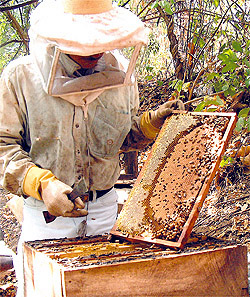
The beekeeping is raising bees in hives established by man in order to take advantage of products These insects develop in the future. Honey is the food of bees when it completes the process of work of these insects and gets the sweet treat the beekeeper replaced by sucrose for food derived from corn to ensure the continuity of the hive. The beekeeper removed the wax comb that coats the cells to reach the honey, then filtered to remove impurities. Later the leaves where it ends consolidated containers before packaging. This type of has built a hive pieces called "cazapolen" or "atrapapolen" it also ensures the conservation of honey from the pollen. Separate wax of honey in many cases is used in cosmetics, for example, soaps, and also to make more panels, which facilitates the work of bees.
We can find different types of honey as the time of production , spring honey produced until late May; main honey from June to July, and honey late August to September. According to the vegetable , differs between blossom honey and forest honey dew or bees produce honey latter type sucking sap directly and secretions of some trees.
 |
| Source: www.nutricion-dietas.com |
The plants visited by bees are the rosemary, thyme, savory, sunflower, sage, heather, purple, orange, lemon, oak, eucalyptus, pine, lavender , among others. Honey is a complex biological product whose nutritional composition varies flora so many times before that there are beekeepers choose to plant certain plants producing or placed in a particular area. The flowers from which bees have nectar obtain honey transmitted all its value and functional characteristics. In addition honey has many medicinal properties and energy, vitamins, carbohydrates, minerals, iron and calcium .
order for children to complete the information click in this
link.
 Space is limited


